Why I Think Creator Marketing Beats Paid Ads for App Growth
Paid ads rent attention. Creator marketing borrows trust. Here's why the economics favor affiliates for most app developers — and why it's not a slam dunk.
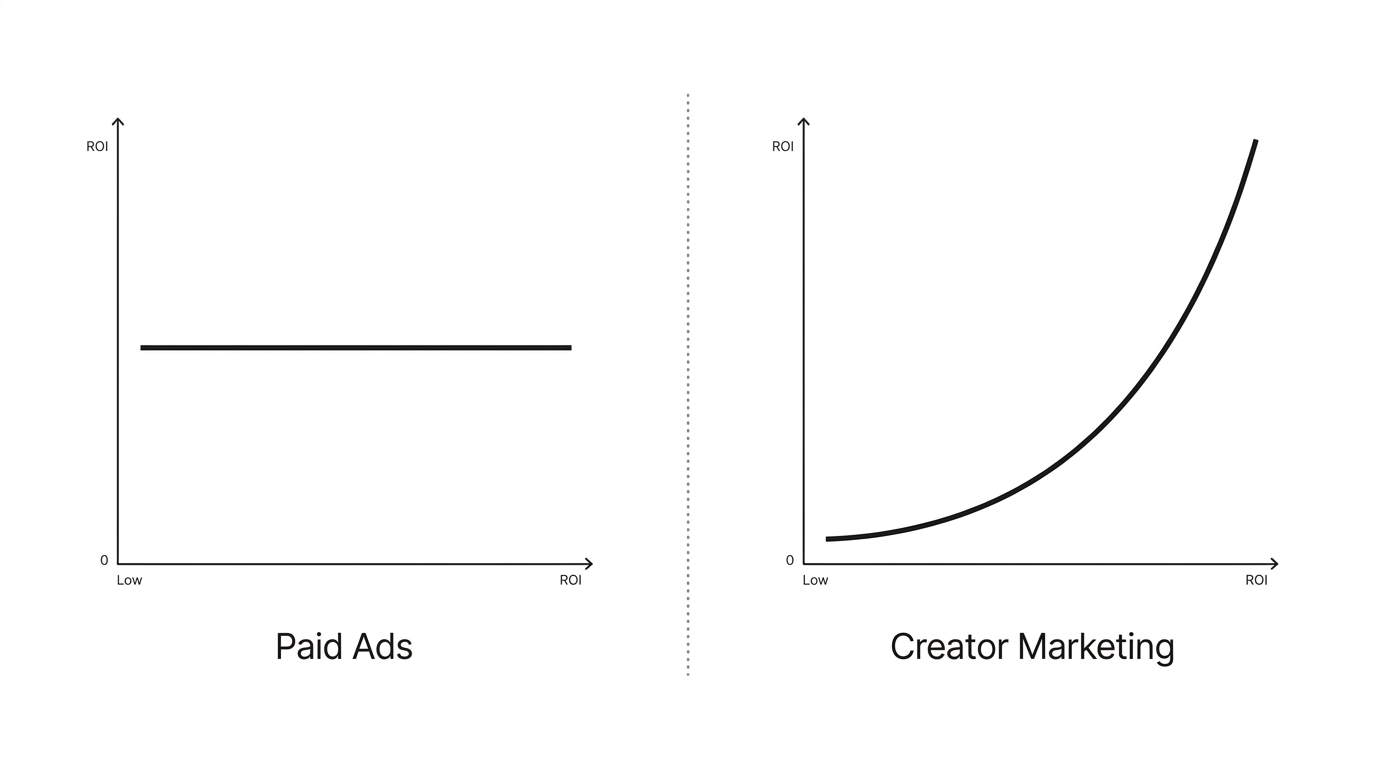
If you’ve been around the mobile app block a time or two, you’re well aware of the drill. You spend some money with Meta or TikTok, collect a few installs, crunch the numbers, and compare what you paid for those users to the amount they’re actually worth. The conclusion is never fun. And you get to do it all again the next month. Stop spending, and the installs stop coming. That’s that.
Paid ads are rented attention. No residual growth, no compounding. Just a hamster wheel.
The math only seems to be getting uglier, too. According to Liftoff’s newly released 2025 Mobile Ad Creative Index, the median cost per install across both iOS and Android jumped 22% year-over-year, with gaming apps now averaging $4.30 per install and non-gaming apps coming in around $3.80. For subscription apps, where the goal is to keep users in the app long enough to actually subscribe, those costs can really add up. AppsFlyer’s 2025 State of App Marketing report says 68% of paid iOS installs never open an app a second time. You’re paying more for less.
That’s the crux of the argument, really. Advertising is persuasion. A creator recommendation is endorsement. Those are two different things happening in your brain. A paid ad is interrupting someone and trying to persuade them that your app is worth downloading. You’re overcoming their ad skepticism the whole time. Edelman’s 2025 Trust Barometer says 38% of people trust social media ads from brands, but 63% trust product recommendations from influencers and other individuals. That’s a real difference and you see it in every single metric. When a creator is sharing your app? They’re lending you their credibility. Their audience trusts their judgment. The user isn’t sitting there thinking “is this ad trying to trick me?”; they’re thinking “if they use it, maybe I should try it too.” You cannot replicate that trust transfer with ad creative. Doesn’t matter how good your copy is. Even the trend of trying to make ads look like content, the “raw” iPhone-recorded ad with no branding, proves the point. Marketers are trying to approximate the trust transfer that creators offer. But people are getting better at detecting it. A 2025 Kantar study says Gen Z can spot “organic-style” ads in 1.5 seconds and their engagement drops by 47% once they realize it’s an ad.
How does intent quality differ between creator and ad-driven installs?
The intent behind creator-driven installs is typically much stronger. People have consumed content about an app before the link was tapped. They know what to expect. Many paid ad installs are impulsive. Someone clicked a picture they liked and often don’t read the full description in the app store. A significant number of paid ad installs don’t even open the app, or open it once and leave because it didn’t deliver what the ad promised. Higher intent at install typically leads to better retention, conversion rates, unit economics, etc. I don’t have a benchmark on how much better because it varies by category, creator, audience, etc. but in general this makes sense. A user that heard, “this is the app I use every morning” will be more likely to stay than a user that clicked a banner ad while scrolling. Sensor Tower’s 2025 App Retention Benchmark Report show organic and referral users have Day 30 Retention rates ~2.5x higher than paid users in the productivity category. In health and fitness the difference is closer to ~3x. This retention gap compounds out into everything: trial -> paid conversion, renewal rates, LTV, etc. When your users want to download an app, they behave like it.
How does creator content compound while ads don’t?
I think this one’s underrated. Paid ads are linear. You spend money, you get results. You stop spending money, you don’t get results. Creators can compound. A YouTube video about your app will generate some installs the day it goes live. But then it’ll keep generating installs as more people search for it over the coming months. Good content is an asset that can last for a long time. Over time, a creator program will build up a stack of content that’s just sort of… running in the background. The CPIs get cheaper and cheaper over time, whereas with paid ads, the cost of installs tends to increase over time as you exhaust audiences. I’ve seen this in action and it’s pretty consistent. A good YouTube video will generate 40% of the installs it’s ever going to generate in the first week, but then it’ll just keep getting more and more installs over the next 6-12 months as it racks up search views. According to Tubular Labs’ 2025 content longevity data, 35% of a YouTube video’s lifetime views come after the first 30 days. For tutorial and review content, which is exactly the kind of content that can help sell an app, it’s more like 55%. Your creator made a video, and six months later it’s still sending you positive ROI installs. You can’t really get that with a TikTok ad. Written content and blog posts have a similar compounding effect, especially when it comes to search. If your creator can make an in-depth review of your app that ranks for the right keywords, they can generate installs for years. You only paid for it once.
Why is pay-for-results better than pay-for-impressions?
No matter what, you pay for impressions or clicks on ads. A user can click your ad, look at your listing for half a second, and leave. You still pay. With affiliate marketing, you can pay for what you want: per install, per purchase, revenue share, etc. You only pay when something valuable happens to you. For a bootstrapped app, that’s a much better risk profile. For example, you can pay $5,000 for 1,200 installs with ads. That’s $4.17 per install. Of those, some will convert to paid, some won’t. Your effective cost per acquisition (CPA) for a paying customer might be $35-50. With a RevShare model at 20%, you don’t pay until someone subscribes. Your cost per acquisition is fixed as a percentage of revenue, and by definition, that’s always profitable at the unit level. You can’t mess it up and blow all your budget on a creator campaign, the way you can on a Friday afternoon when your Meta ad just decides to spend $800 targeting the wrong lookalike audience. If you’re interested in the details, here’s how to set up an affiliate program for your mobile app.
What are the downsides of creator marketing?
I talk to a lot of app developers who use creator marketing to drive installs. But creator marketing isn't right for every app. Here are the downsides:
- It takes time. If you need installs this week, paid ads are a better option. It can take weeks to launch a creator program, between finding the right creators and building out the campaigns themselves.
- It's tough to tell if it's working when you first start out. If you're only working with 5 creators, you don't have statistically significant data. If three of those creators produce zero installs, that doesn't mean the channel is broken. It means you haven't found the right creators yet. But that feels like wasted time, and it's frustrating.
- The quality of users is inconsistent. Some creators will deliver really engaged users who love your app. Others will deliver users who uninstall after a day. That's why per-creator tracking is so important. The spread here is wider than with paid ads, where quality is more predictable (if predictably mediocre). To really benefit from creator marketing, you need enough creator relationships to iron out that spread. For example, Influencer Marketing Hub found in 2025 that performance varied 5-10x between the best and worst creators in the same niche.
- You lose some degree of control. Paid ads gives you a dashboard and a set of levers to pull. Spend more here, less there, tweak the targeting, swap out the creative. Creator marketing is more chaotic. You're working with people rather than an algorithm, and that can be disorienting for marketers used to the control of paid channels.
- You introduce some brand risk. A creator says something off-brand, or their content ages poorly, or they get into a controversy, and your app is attached to that content. This risk is manageable with the right vetting and guidance for your creators, but it's real in a way that display ads aren't. That said, most indie developers put too much emphasis on this risk. Your 15K-follower fitness creator is not going to cause a PR crisis.