How to Set Up an Affiliate Program for Your Mobile App (2026 Guide)
A practical guide to launching a mobile app affiliate program — commission structures, mobile attribution, and recruiting creators who actually move the needle.
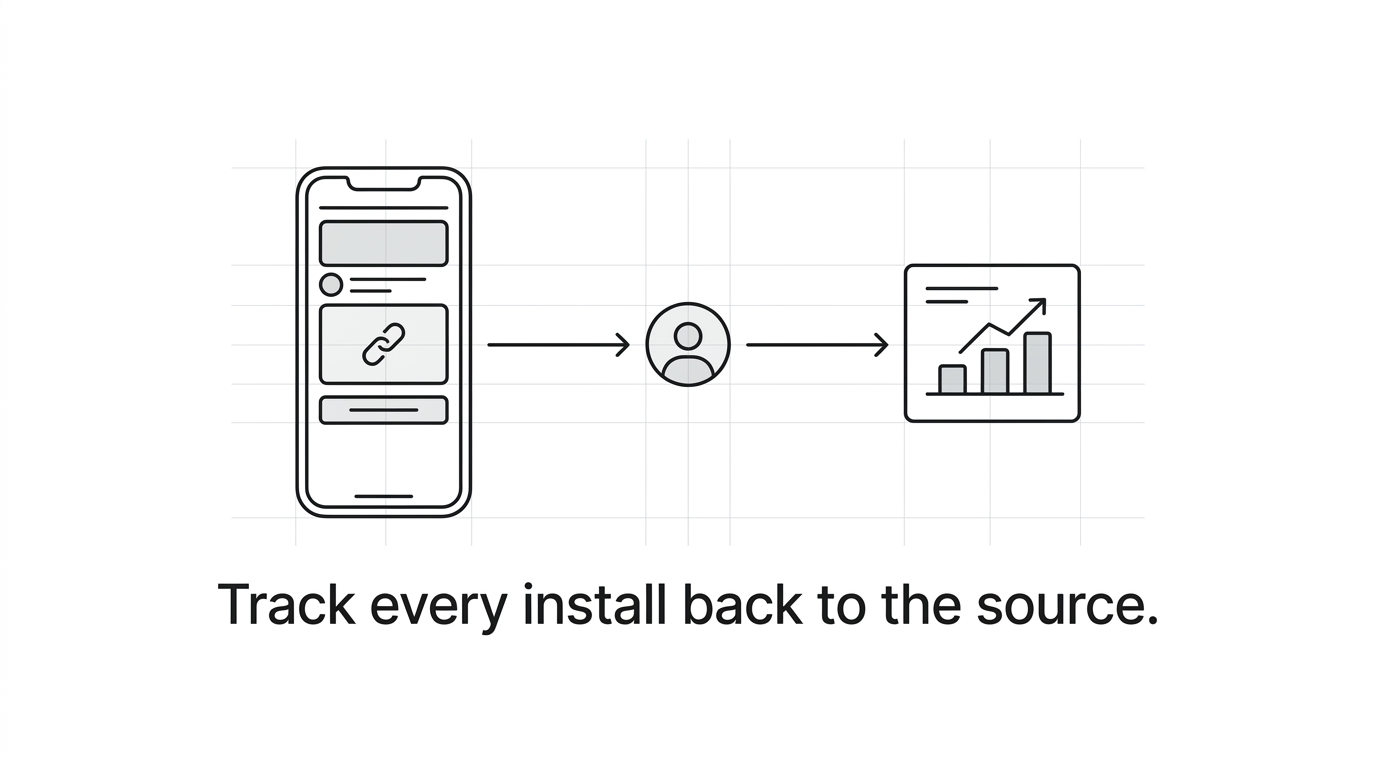
Why are paid acquisitions failing app developers?
CPIs increase every quarter. You pay more money to Meta and TikTok, get the same number of installs, and the quality is somehow worse than the people who came to you organically. It works until it doesn’t. According to Liftoff’s 2025 Mobile Ad Creative Index, the median CPI rose 22% year over year, to $3.80 per install for non-gaming apps. If you’re a subscription service that requires users to pay within a free trial period, that can get expensive quickly. According to Sensor Tower’s 2025 data, the average rate of ad-driven conversions to paid subscribers is 3-5% across most categories. If we do the math on that $3.80 average CPI with a 4% conversion rate, we’re looking at $95 in cost per paid subscriber. That’s a tough pill to swallow for a $9.99/month service. Affiliate marketing reverses this. You’re not paying for eyeballs and hoping for the best. You’re paying for outcomes: installs, purchases, or both. And users who arrive from a creator’s link already have context. They understand what your app does. They downloaded it because they wanted to. I’ve been puzzling this out for some time, so this is how I would approach an affiliate program for a mobile app today.
What commission structure should you use?
You can pay creators per install (CPI), revenue share (RevShare), or some combination of both. RevShare is the right choice, and it’s not complicated to understand why. CPI is simple: I’ll pay you $2 per install. But the incentive is wrong from the outset. Creators are incentivized to deliver as many users as possible, regardless of whether they’ll be active. And you’ll wind up paying for installs of people who open an app once and never use it again. It also draws in the wrong type of creators, people who have a lot of users who click links, but the users don’t actually need what you’re offering. RevShare corrects this. If a creator is going to earn 15-20% of the revenue generated from the users they deliver over 12 months, they’re going to want to promote your app to users who will actually remain active. That means that a creator that delivers a high quality 2 minute video will outperform a creator that just posts “link in bio” to an inactive audience, and will be compensated accordingly. The counterpoint here is that you won’t be able to find creators unless you offer them money upfront. But most of the time, creators can accept deferred payments. Creators are already collecting YouTube AdSense revenue, and are already getting paid net-30 and net-60 by brand deal partners. What matters most to creators is whether they like the product, and whether the commission rate is equitable. If they earn 15-20% of subscription revenue, that’s going to be many orders of magnitude higher than a one time $2 payment for any creator that can actually convert their audience. According to the Influencer Marketing Hub 2025 Benchmark Report, the average RevShare payout is 3.5x higher than the equivalent CPI payout over a 12 month window. Creators will understand that very quickly. If they have an option to select RevShare or CPI, good creators will always choose RevShare once they understand the payouts. Creators that demand flat rate CPI are almost always creators whose audiences don’t convert, if that tells you anything. If you absolutely have to, you can offer a small CPI bounty ($1-2) for the first month as a signing bonus to get creators in the door. But that should be temporary, your long term structure should be RevShare.
How does mobile attribution actually work?
Tracking is simple on the internet. Fire a cookie when someone clicks a link and read it when they make a purchase. That’s it.
It’s trickier on mobile, and we go deep on the technical details in our post on how attribution works for mobile apps. The user clicks the link in the browser, then gets redirected to the store, and finally opens the app. That app has no idea that the user came from the link. The browser session and app session are not connected. That’s the underlying technical challenge.
Android has a rock solid, deterministic way to pass the referrer details from the Play Store. If someone clicks a tracking link and installs from Google Play, then the app can tell which link they originally clicked when the app launches for the first time. It’s deterministic. No guesswork.
Google’s Install Referrer API has been available and well documented since 2017, and works on the overwhelming majority of Android devices. According to the 2025 Google Play Store developer documentation, the referrer is available for up to 90 days after the click so there’s plenty of time for delayed installs. It’s one of the few things in mobile attribution that just works.
Apple doesn’t have anything similar. With App Tracking Transparency, most users are opting out of cross-app tracking so IDFA is effectively useless for this. We dive deeper into this in our piece on attribution without IDFA.
iOS attribution works via privacy-preserving techniques that don’t require IDFA or fire the ATT prompt. Your users never see the Allow this app to track you? pop-up, and your App Store conversion rate remains unaffected. The attribution isn’t perfect, as it depends on how and where your creators share links, but it’s good enough to run an attribution program on.
The key thing to internalize here is don’t try to build this yourself. Mobile attribution is a fiddly, horrible problem with edge cases that multiply with each OS version. You’ll sink months into something that isn’t your product. I’ve spoken to several developers who tried building their own attribution system and every single one of them regretted the decision within 6 months. There are edge cases for VPNs, shared IPs, delayed installs, device churn, and OS-specific edge cases that breed faster than you can fix them. Use an attribution provider; we put together a guide to help you choose one. Integrate their SDK, usually a couple of lines of code, and then focus on the rest of the program that does require your attention.
How do you find and recruit the right creators?
The temptation here will be to try to get as many as possible. Don’t. I would rather have five creators who actually use my app than fifty who have never even opened it.
First, find the ones who already use your app. Go through your App Store reviews, your Twitter mentions, your posts on Reddit. If someone is already saying something positive about your app, that person is someone who you should be reaching out to. They actually know and (hopefully) love your app, and will be able to pitch it way more effectively to their followers than someone who doesn’t actually use your app will. In a 2025 study, CreatorIQ found that “affiliates who were customers before applying to the affiliate program converted at 2.7x the rate of affiliates who joined the affiliate program without previously being customers”. It makes sense, as the former group actually knows and cares about your app. And you can tell.
Smaller is better. Someone who has 8,000 followers and actually makes content about your app’s niche (if your app teaches you a new language, then this person makes videos about learning new languages. If your app helps you to lose weight, they make videos about weight loss. Etc) will almost always drive more high quality installs than someone who has 200K followers but doesn’t actually make content about your niche. The size of someone’s following is nowhere near as important as their engagement rate and the intent of their audience; in 2025, Influencer Marketing Hub found that “generally, micro-influencers (from 10,000 to 50,000 followers) achieve between 3 and 4 times as much engagement as macro-influencers (500,000 and more followers)”, and that “on average, a micro-influencer’s followers are twice as likely to convert as a macro-influencer’s are when it comes to mobile apps”. This is not surprising, as micro-influencers have built an audience around one topic that they care about and actually know a lot about, so their endorsement is going to carry way more weight than someone who has built an audience around something else entirely.
Your initial message should be no more than three paragraphs. In the first, you want to tell them a bit about what your app does, why you think that their followers would care about it, etc. In the second, you should tell them what you are proposing. In the third, you should tell them how this process would work. You do not want to send them a three page long contract, nor do you want to send them a twelve page long brand guide. You’re starting a conversation; if they are interested in it, you can send over more information later. If they are not, well, you haven’t wasted very much time.
Finally, make sure that you are setting creators up to succeed. Once they have agreed to work with you, give them everything they need and let them go. This should include a one sentence description of what your app does, three-four bullet points of things about it that you think their audience would like, and your affiliate link. You should not be sending them a twelve page long brand guide, nor should you be dictating to them exactly what they should say. This defeats the point of working with a creator in the first place, because the reason you want them making content about your app is because they know their audience way better than you do. Let them do what they do best.
How do you measure and optimize your program?
Now that you have your attribution SDK up and running, and a few content creators live with tracking links, it’s time to observe. See which content creators are driving installs that ultimately become paying users (this is why you chose revenue share). If you want a deeper dive on measuring creator ROI, we wrote a full guide on how to measure UGC ROI for your mobile app. You can now measure which content creators are driving users who retain. Share this information with your content creators. The best ones will want to understand what’s working and double down on it. Do not worry about the results of week 1. There will be so much noise in the data. One content creator may have driven 40 installs while another drove 2. This is okay. You won’t have signal until at least week 2, when you can see retention and conversion. Avoid making any decisions or cuts in week 1. At day 30, you will have enough data to start making decisions. Which content creators do I want to double down on? Is my commission rate competitive enough to attract even better content creators? Are there certain formats of content (e.g. long form review vs. short form demo) that result in higher quality users?
Why does an affiliate program compound over time?
This is where the flywheel really kicks in. Your top creators recruit other top creators. Your attribution gets more precise as it gets more data. And unlike paid ads, you're forming relationships with people that have an incentive to keep promoting your app every month. I really think the compounding factor is undervalued. A 2025 Partnerize study found that established programs (12+ months) lowered their cost per acquisition by an average of 35% versus their first quarter, despite increasing overall volume. That's the opposite of paid ads, where costs usually rise as you saturate your highest value audiences. The affiliate programs that fail are the ones that aren't looked at after they launch. The ones that succeed have someone checking the data in those first months, realizing that an 8,000-subscriber channel converts better than a paid campaign that hits 200,000 people, and realizing what that means for how you should be spending your growth budget.
What are the most common mistakes that kill affiliate programs?
I’ve been around the block a few times. I’ve seen these programs get off the ground and sputter out. Here are the top reasons why they fail. Low commission payouts. You’re offering 5% revenue share while another app is offering 15-25%. Your program is getting ignored. You need to be competitive. No communication after the welcome email. Just because you sent your affiliates a welcome email doesn’t mean you’re off the hook. You should be emailing them once a month, showing them how they’re performing, helping them understand which types of content is converting best for your app, etc. I’ve seen plenty of programs that don’t do this, only to lose their best performing partners to the other programs who do. Tracking pure installs. This is the wrong metric. You want to track revenue generated per creator. If you’re only tracking pure installs, you’re going to end up thinking some creators are crushing it while others suck. But what you’re not accounting for is that some creators send low quality traffic who ultimately don’t spend money on your app. If you track revenue per creator, you’re going to be able to see which of your creators are actually adding value. Over expanding the program too quickly. You start with 5 creators. They do okay. So you want to grow to 50 creators in the first month. This is not a good idea. You haven’t tested anything yet. You still don’t know your model, or even if your attribution tracking is working correctly. Just like anything else in life, slow and steady wins the race. Add 5-10 new creators a month. Once you figure out your model in the first 30 days, continue to expand it at a measured pace that your data dictates. It’s not sexy, but it’s the truth.