Why Creator Marketing Works Better for Subscription Apps
Subscription apps have a unique advantage with creator marketing — recurring revenue means a single referred user keeps paying. Here's how to use that.
I’ve written a lot about the state of app growth and what works for driving installs. But most of what I’ve written has been fairly horizontal, that is, the advice applies broadly to most types of apps out there. Want to grow your casual game or your fitness app or your paid productivity app? I’ve got a playbook that’s fairly consistent across all three.
But there is one HUGE difference between subscription apps and other types of apps that almost nobody has explored properly. It’s so basic that I feel dumb even writing about it. But hear me out, because it’s a big deal:
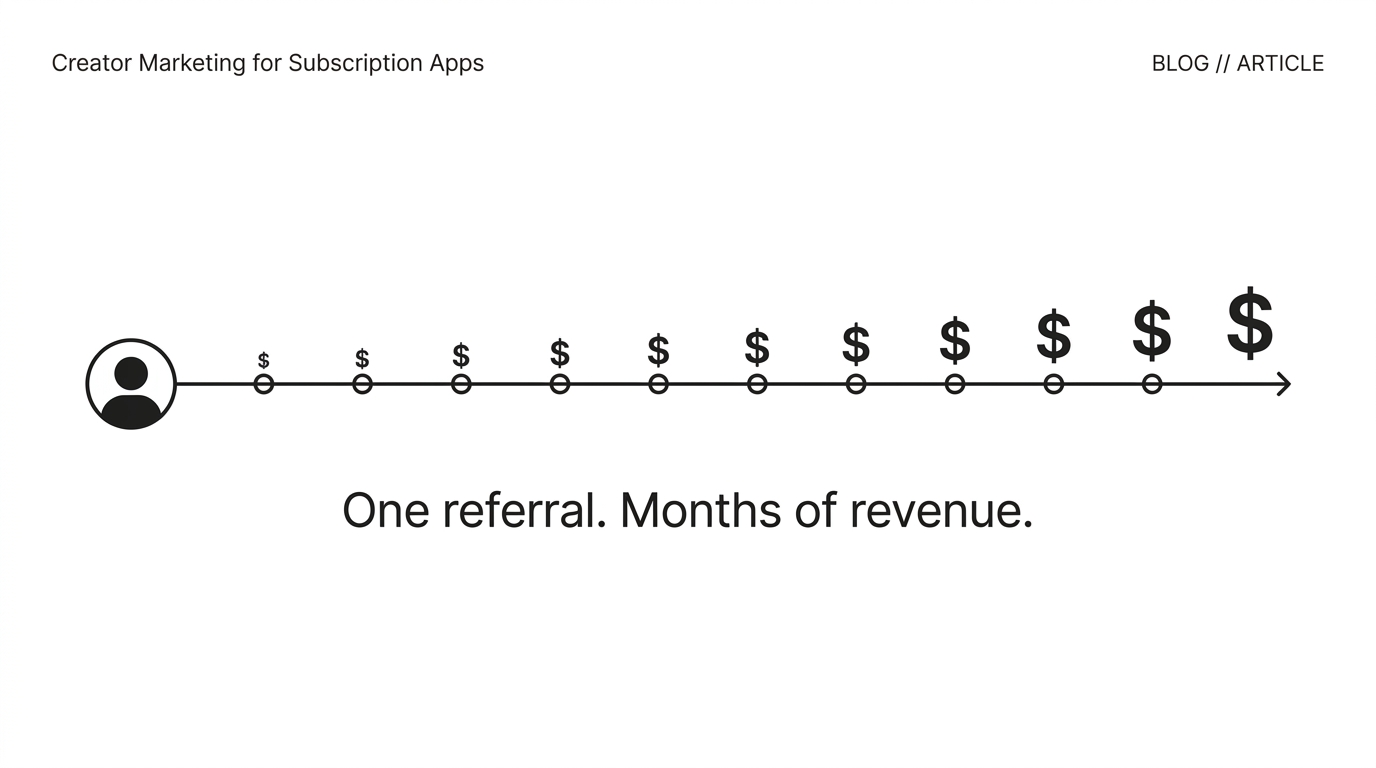
If you have a subscription app, every user a creator drives to your app is worth way more than a user in a paid or ad-supported app.
Why? Because those users pay you every month! Let’s do a super simple example to illustrate this. If a creator refers someone to download a paid app from the app store for $4.99, that’s all the money you’ll ever get from that user. But if a creator refers someone to subscribe to your app for $9.99, and that user stays for 8 months, that install was worth $79.92 to you. Same effort from the creator. $4.99 vs $79.92.
This is huge! It means you can:
Pay more to creators than other apps can, and still make money on every install
Offer higher revenue share commissions to creators
Be more patient with campaigns that look terrible in the first month but amazing after a few months
I just got a copy of the 2025 RevenueCat State of Subscription Apps report. Two statistics jumped out at me, on annual subscription plans, the median subscriber retains for 7.2 months. On monthly plans, the median is 3.8 months. That’s a ton of revenue that you’re getting from every single install.
If you have a subscription app and you’re not doing creator marketing, you’re missing out on the single best growth channel available for your business model. Full stop.
Why does revenue share make more sense than CPI for subscriptions?
CPI is fine for one-time purchase apps. You know the value of each user, and it’s fixed. You pay $2, the app is $4.99, you know your margin.
For subscription apps, CPI is a bad deal for creators and a missed opportunity for you.
Here’s why. Let’s say you pay creators $2 per install. A good creator gets you 100 installs and earns $200. But 8 of those users subscribe at $9.99 and stick around for 6 months. Those 8 users got you $479.52 in revenue. You paid the creator $200 for almost $500 in revenue. That mismatch creates two problems: the creator will eventually realize they’re underpaid and leave, and you have no way to reward quality over quantity.
Revenue share solves both. Instead of CPI, pay 20% of revenue for 12 months. Now that same creator earns $95.90 for those 8 subscribers… in month one alone. Over a year, if those 5 of those subscribers stick around, that creator earns way more than $200. And more importantly, the creator now has an incentive to find users who will subscribe and stick around, not just users who install and disappear.
A 2025 benchmark study by Partnerize found that affiliate programs using revenue share models had 40% higher partner retention rates than programs using CPI. Any wonder why? Revenue share means your best creators get paid what they’re actually worth.
We dug deeper into the commission structure question in our guide to setting up an affiliate program, but the tl;dr for subscriptions is that your revenue model and your creator payment model should match. Recurring revenue -> recurring commissions.
How do the economics of subscriptions vs one-time purchases compare?
Consider these two scenarios for a fitness app with a monthly subscription price of $9.99:
Scenario A: A creator delivers 500 one-time purchases at $2.99
The creator’s total cost to you: $500 flat fee. Total revenue: $1,495. Profit: $995. Not bad. But that’s it. You don’t earn any more money from those users. Next month, you have to pay again.
Scenario B: A creator delivers 50 $9.99 monthly subscriptions
The creator’s total cost to you (20% rev share): $99.90 per month for as long as the users are subscribing. Month 1 revenue: $499.50. Month 1 profit after rev share: $399.60.
But the subscribers keep paying. According to Sensor Tower data from 2025, the average monthly subscription app has a 6-month retention rate of about 35% for users acquired from trusted referrals. So after 6 months, perhaps 18 of those 50 users are still subscribing. That’s $179.82 in monthly revenue, $143.86 after rev share. And you’re still earning from a single campaign.
The cumulative revenue over 6 months from 50 subscribers: about $2,100. The cumulative rev share you’ve paid the creator: about $420. Your take: about $1,680, and growing.
The 500 one-time purchases top out. The 50 subscriptions compound. That’s the entire value proposition for creator marketing with subscription apps, in a nutshell.
One creator who delivers 50 subscribers per month is more valuable to your business than a paid ad campaign that delivers 500 installs at a $3 CPI. The installs are cheaper, but they’re worth less. The subscribers are more expensive up front, but they keep paying.
How do you connect subscription platforms to track recurring revenue per creator?
How do you get that data? By linking your subscription platform to your attribution platform. That's what almost every team fails to do. They set up their tracking links and they can see the installs that each creator is delivering, but then they stop. They have no idea how many users from each creator converted to a paid subscription, or how many are still paying after three months.
The two most common subscription platforms I see are:
RevenueCat + Appfiliate:// iOS
Appfiliate.configure(appId: "APP_ID", apiKey: "API_KEY")
Appfiliate.trackInstall()
Appfiliate.setUserId(Purchases.shared.appUserID)// Android
Appfiliate.configure(this, appId = "APP_ID", apiKey = "API_KEY")
Appfiliate.trackInstall(this)
Appfiliate.setUserId(this, Purchases.sharedInstance.appUserID)The setUserId method connects the attributed install to the RevenueCat subscriber. Then every time a purchase is made, a subscription is renewed, or a subscription is canceled, a webhook is automatically fired back to the attribution platform. You never need to call a method like trackPurchase(). RevenueCat notifies you whenever money changes hands.
Same idea, different ID. Use the Stripe customer ID instead:
Appfiliate.configure(appId: "APP_ID", apiKey: "API_KEY")
Appfiliate.trackInstall()
Appfiliate.setUserId(stripeCustomerId)
And configure Stripe to send an invoice.paid event and a customer.subscription.deleted event to the Appfiliate webhook URL. Every renewal is automatically attributed to the creator who drove the original install.
It's surprisingly simple. Three lines of code and you paste a Webhook URL into your subscription platform's dashboard. The tricky part isn't the integration, it's choosing to integrate in the first place. Most teams never hook their attribution system up to their subscription system. That's why they don't know how their creators are performing. If you're trying to decide which attribution tool to use, we compared the main options for creator campaigns.
How do you track trial-to-paid attribution per creator?
This is the difference between a good creator program and a great one for subscription apps, and it’s a metric that almost no one is tracking.
The majority of subscription apps have a free trial period: three days, seven days, two weeks. A creator gets someone to install your app, the user starts a trial, and then… do they convert to a paid subscription? The delta between “started a trial” and “became a paid user” is where all the signal is.
According to a 2025 RevenueCat report, the average conversion rate from free trial to paid user is around 45-55% across all subscription apps, but it fluctuates widely depending on where the user was acquired. If they came through a creator’s recommendation, they convert from free to paid at a significantly higher rate because they had high intent going in. They watched a video about your app, they knew what it did, they weren’t just mindlessly tapping on an ad because it looked shiny.
When you integrate your subscription platform via webhooks, trial starts and conversions are tracked automatically. So you can see: Creator A generated 80 trial starts, 52 converted to paid (65% trial-to-paid). Creator B generated 120 trial starts, 30 converted to paid (25% trial-to-paid). Creator B looks way better on installs and trial starts, but creator A is actually bringing you dramatically more valuable users.
This is an insight you can’t possibly have without integrating attribution and subscription data. And it should shift who you’re willing to invest in. Creator A’s users actually want your app. Creator B’s users are just intrigued. Same cost per creator; wildly different outcomes.
Why does creator content compound for subscription apps?
I keep hearing people talk about creator marketing as a "campaign", as if you run it for a month, check results, and decide whether to do another round. That framing misses the best part. Creator content is a long-lived asset. A YouTube video reviewing your app doesn't disappear after a week. It sits in search results, gets recommended by the algorithm, and keeps driving installs for months. A 2025 Tubular Labs analysis found that the average YouTube review video generates 60% of its total views within the first 30 days but continues accumulating views for 6-12 months after publishing. For app reviews specifically, search-driven discovery means some videos drive more installs in months 3-6 than they did in month 1. Now layer the subscription model on top. That YouTube video from January is still driving 5-10 installs per week in June. Some percentage of those installs convert to subscribers. Those subscribers keep paying. Meanwhile, the users the video drove in January are still paying too (at least the ones who retained). So you have: Content compounding: Each piece of creator content keeps driving installs over time Revenue compounding: Each referred subscriber keeps generating revenue over time Both happening simultaneously After 6 months of a creator program with even 10-15 active creators, you have dozens of pieces of content quietly driving installs in the background, and hundreds of referred subscribers generating recurring revenue. Your effective cost per acquisition drops every month because the content is already made and the subscribers are already paying. Compare this to paid ads, where you spend $10K in January and get installs in January. In February, those installs are done. You spend another $10K. Repeat forever. We wrote about why creator marketing beats paid ads for app growth more broadly, but the subscription angle makes the contrast even starker.
When does creator marketing NOT work for subscription apps?
So let’s be clear on the exceptions. 1. Very low price points. If you’re charging $1.99/month for your subscription, it’s tough. 20% revenue share is 40 cents a month per customer. You’d need a huge following and even then you’d need to send hundreds of paying customers to make it worth it. At prices below about $5, unit economics actually favor flat fees or CPI over revenue share. 2. Very high churn. If your average customer churns in less than 2 months, you don’t get the compounding benefit. Fix your churn before leveraging creators. Sending more customers into a leaky bucket is a waste of time. 3. No product market fit. Creators can’t sell an app that doesn’t sell. If your trial to paid conversion rate is < 20% across the board, you have a product problem not a marketing problem. No amount of creator content is going to fix a bad onboarding flow. 4. Categories with no natural creator ecosystem. Certain app categories don’t really have creators that make content about them. Enterprise tools. Niche utilities. Highly technical apps. You need creators that can make content about your product. If that doesn’t exist on YouTube or TikTok, it won’t exist as a channel for you. But for the vast majority of subscription apps, fitness, health, productivity, education, finance, entertainment, social, creators are the best growth channel you’re probably neglecting. The recurring nature of the revenue makes every referral worth more. Revenue share aligns incentives perfectly. Content compounds. Customers compounds. And unlike paid advertising, it’s something that gets cheaper and more effective over time instead of more expensive. The apps that get this right are going to have a structural advantage. The apps that just keep dumping more budget into paid acquisition are paying for installs on a treadmill and that treadmill is going to keep speeding up.