Appfiliate vs AppsFlyer vs Branch: Which Is Right for Creator Campaigns?
An honest comparison of mobile attribution platforms for app developers running affiliate and creator programs. Different tools for different jobs.
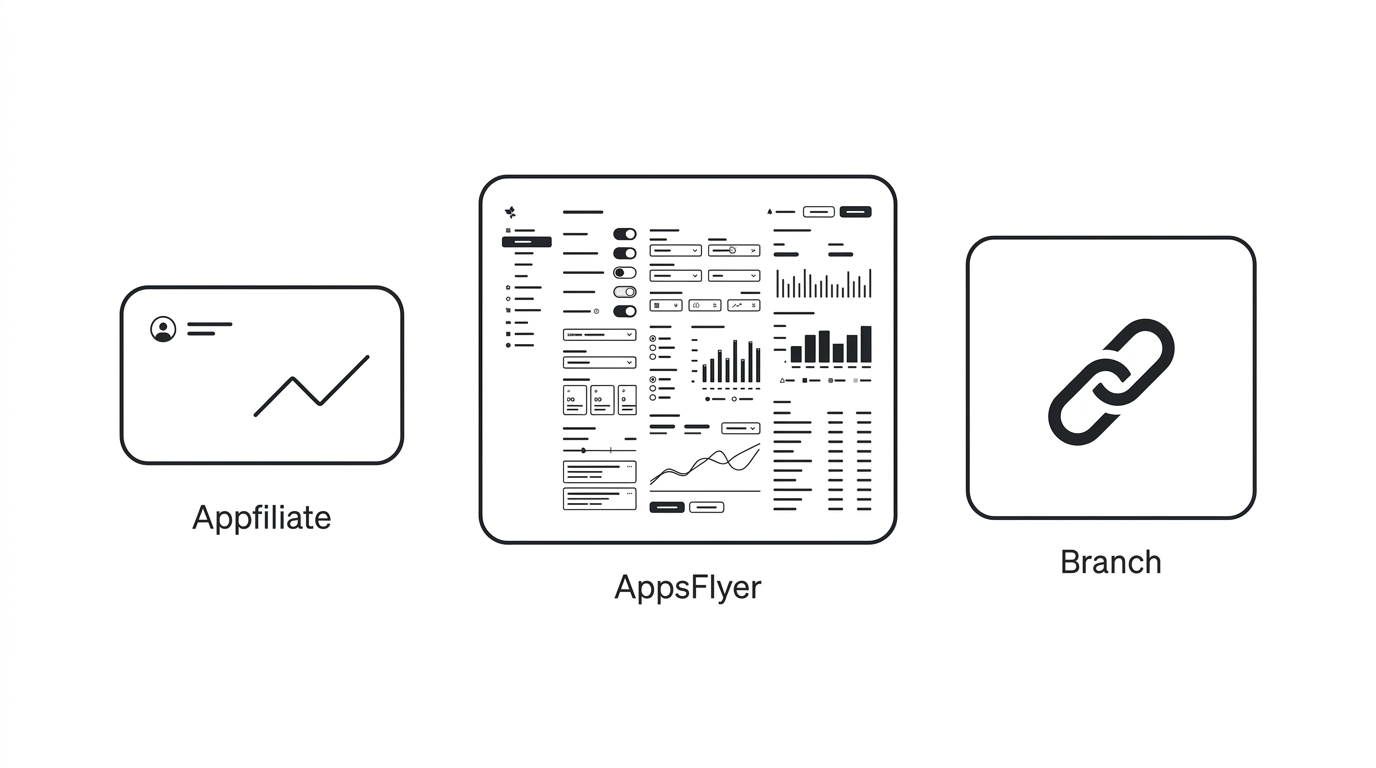
How does Appfiliate compare to AppsFlyer and Branch?
We built Appfiliate. So yeah, grain of salt and all that. But we spent months looking at AppsFlyer and Branch before deciding to build something new, and both platforms are genuinely great at what they do. They just weren’t built for the thing we needed.
This is my honest breakdown of when each platform makes sense. Including when Appfiliate doesn’t.
AppsFlyer. They’re the enterprise MMP. They integrate with 100+ ad networks. They tell you which campaign led to which install and what the return was. Their fraud detection (Protect360) is truly best-in-class. Click flooding. SDK spoofing. Install fraud. No one does that better than them. Their SKAN support is mature. If you’re doing real paid advertising, AppsFlyer has rightfully earned their seat at the table. According to their own 2025 data, they count north of 7 billion installs every year on their platform. And that volume provides them a level of fraud protection that no one else can match. Branch. They own deep linking. Someone clicks a link, installs the app, and lands on the same content they were looking at on the link… Branch is the best at this. Referrals. QR-to-app. Web-to-app. All good. They’re actually into attribution now too, but deep linking is their game. In one 2025 Branch case study, they saw that deferred deep linking can improve conversion post-install by up to 3x vs. dropping people on a generic home screen. When you need context preservation, they’re tough to beat. Appfiliate. Specifically for affiliate/creator-driven campaigns. Tracking links by creator. A login for the creators where they can see their own performance. Commission tracking (CPI, RevShare, hybrid). Revenue attribution by creator. That’s it. Small footprint, by design.
How do the features actually compare?
| Feature | Appfiliate | AppsFlyer | Branch |
|---|---|---|---|
| Ad network integrations (Meta, Google, etc.) | No | 100+ networks | Limited |
| Fraud detection | Basic | Advanced (Protect360) | Basic |
| SKAdNetwork support | No | Yes | Yes |
| Deep linking | Store redirect only | No | Advanced (deferred, contextual) |
| Per-creator tracking links | Built-in | Manual setup | Possible with config |
| Creator/affiliate dashboard | Built-in | No | No |
| Commission management | Yes | No | No |
| Revenue attribution per creator | Yes | Requires config | Requires config |
| SDK size / dependencies | Lightweight, no IDFA | Full MMP SDK, uses IDFA | Full SDK, uses IDFA |
| Setup time | Minutes | Days to weeks | Hours to days |
| Starting price | $79/mo | ~$500+/mo (contract) | Free tier; enterprise for advanced |
When should you NOT use Appfiliate?
Let me be clear about this:
- You're doing paid advertising on any ad network. Appfiliate doesn't have APIs into Meta, Google, TikTok, or any other ad network. It's not an MMP. Use AppsFlyer.
- You have a real fraud problem. Appfiliate has some basic defenses, but it's nothing like Protect360. If fraud is a real issue at your scale, then it might be worth paying for AppsFlyer. (According to AppsFlyer's 2025 Global Fraud Report, ~22% of global non-organic installs were fraudulent. If you're doing paid acquisition at scale, that's real money that you're losing if you don't have the right fraud tools).
- Deep linking is a product feature for you. Your users share some content, and then the person on the other end of that share needs to be taken directly to a specific screen inside your app, that's a Branch use case. With Appfiliate, we just send them to your app's page on the app store. (Note: If you do need to deep link, we're actually going to integrate with Branch in the future. So this is really a temporary differentiator).
- Enterprise compliance. You have to meet some SOC 2 requirements, or have specific data residency requirements, or need to have really granular role based access. Appfiliate hasn't built that layer yet. First, we need to get attribution right.
- You're going to be spending millions on paid advertising. At those scales, you're going to want cohort analysis, LTV prediction, multi-touch attribution, etc. That's all enterprise MMP type stuff.
When does Appfiliate make the most sense?
Creators and affiliates are driving your installs, and you want to know exactly who’s performing. You want creators to have their own login and dashboard instead of them asking you for screenshots every week. You need commission tracking (CPI, RevShare, or hybrid) without building it yourself. You don’t want to deal with ATT prompts. Appfiliate doesn’t use IDFA; we wrote more about how attribution works without IDFA if you’re curious about the technical side. You’d rather not sign an annual enterprise contract just to track 20 creators. There’s a broader point here that’s worth spelling out. The attribution market has consolidated around tools built for paid acquisition at scale. That makes sense, as ad spend is where the money is, and MMPs earn their fees by optimizing massive budgets. But creator marketing is a fundamentally different motion. You’re not optimizing CPMs across ad networks. You’re managing relationships with individual people who each have their own link, their own audience, and their own commission structure. The tooling requirements are completely different, and shoehorning creator tracking into an MMP designed for ad networks is like using a CRM to manage your personal to-do list. It technically works, but you’ll hate every minute of it.
How does pricing compare across these platforms?
This is likely the most important section of this comparison.
AppsFlyer: $500-$2k per month based on usage, with yearly commitments. There is also custom pricing that is done through sales. Honestly makes a ton of sense if you are spending a lot on ads, the value is there because you are getting the attribution, and that value will cover the costs, but if you are a small studio running a creator campaign, you are paying MMP prices for 1 of the features that the platform offers. A 2025 Mobile Dev Memo survey found that 41% of indie developers who tried AppsFlyer churned within the first year, with “paying for features we don’t use” being the top reason for leaving. Again, this is not meant to be a negative towards AppsFlyer, they simply don’t serve this use case. Branch: There is a free tier, that includes basic deep linking and attribution, this is actually quite generous for smaller applications. For any of the more advanced features (data integrations, custom dashboards, Enterprise attribution, etc.) you will need to talk with sales. This will also scale based on usage and can be quite expensive, but the free tier means you can get started without committing to anything. Appfiliate: $79 a month for Growth (5 apps, 100 Creators, 100k tracked clicks) or $99 a month for Scale (Unlimited apps and Creators, 1M clicks, API). There are no annual commitments and no per-install fees. The simplest pricing of the 3 options, but again, this is also the platform that offers the least amount of features. You are comparing a purpose built platform to platforms that have 10x the amount of features available.How long does each platform take to integrate?
This is worth more than most comparison articles give credit for. The best tool in the world isn’t much help if it takes two months to integrate. AppsFlyer integration is heavy, and time-consuming. You’re talking SDK integration, postback configuration for each ad network, conversion event configuration, fraud rule tuning, and probably some time with their onboarding team. For a team that’s already running significant ad spend, this is worth it. For a three-person team that wants to start tracking five creators next week, it’s overkill. Multiple developers I’ve talked to said their AppsFlyer integration took 2 to 4 weeks including testing and validation. Branch is faster. Their SDK is well-documented and the basic deep linking setup can be done in an afternoon. Attribution configuration takes longer, especially if you’re setting up custom events and data integrations. The free tier removes the procurement friction, which is a real advantage. Appfiliate was designed to be set up in minutes. Three lines of code in your app, connect your webhook from RevenueCat or Stripe, and you’re tracking. We built it this way on purpose; if you’re a small team, the integration cost of an attribution tool should be measured in hours, not weeks.
Can you use multiple platforms together?
These aren’t necessarily either/or scenarios. One very typical scenario is: AppsFlyer or Branch for paid ad attribution and deep linking, and Appfiliate for creator/affiliate campaign attribution. Traffic sources are different, so you’re not double counting anything. Creator link clicks are directed to Appfiliate. Ad network installs are directed to your MMP. Easy peasy. We are actually seeing more and more of this dual stacking as creator marketing takes off. According to Sensor Tower’s 2025 Growth Channel Report, 34% of the top-500 apps now operate a dedicated creator program as a channel in addition to paid acquisition. Those are different channels. With different tooling requirements. And separating them keeps your data clean. If you want to understand what a creator attribution SDK actually does under the hood, we wrote a deep dive on that.