How to Pay Influencers for App Installs (Without Wasting Money)
CPI, revenue share, or hybrid? Here's how to structure influencer payments so you're rewarding quality installs, not just volume.
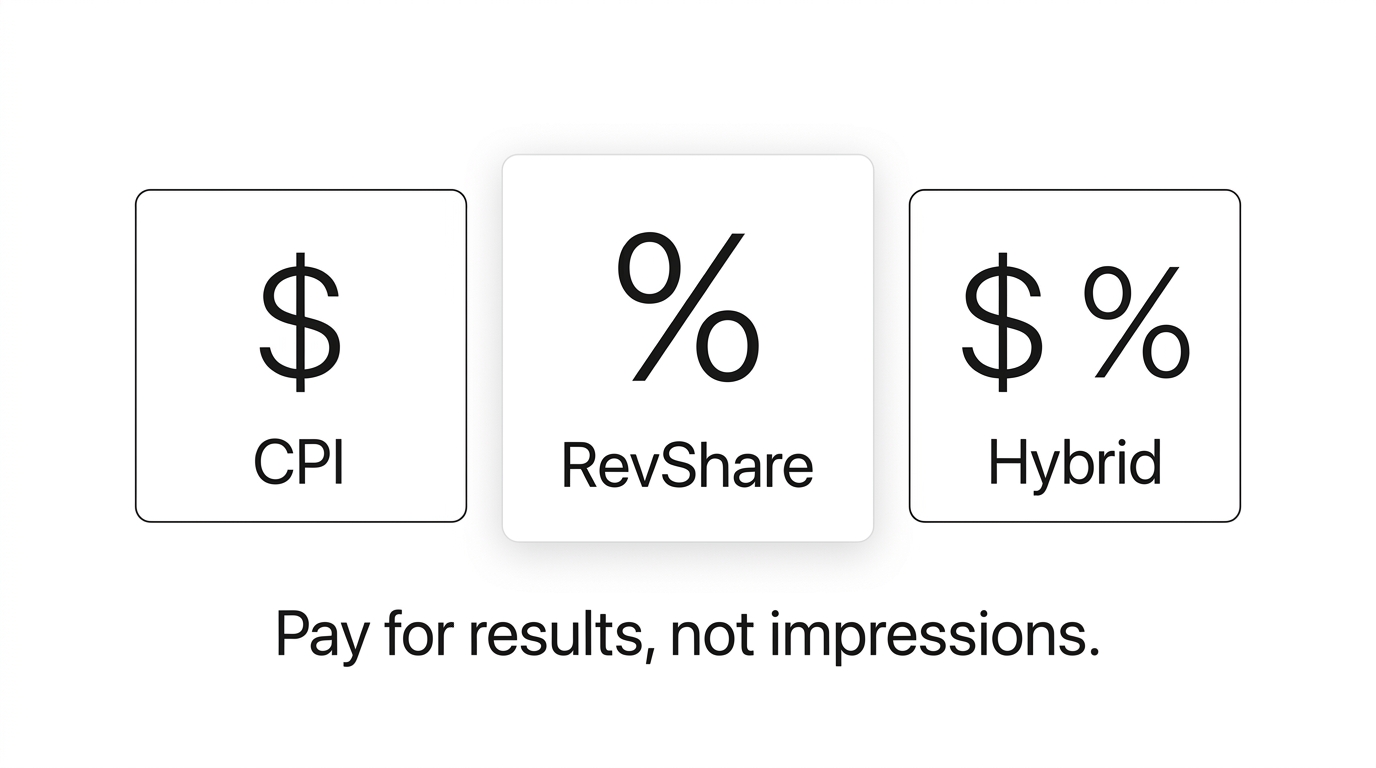
With that, we arrive at the most important question of all: how should you compensate creators? The go-to answer, cost per install, is almost always the wrong one. Almost. Not always. But almost. The issue with cost per install is simple: it incentivizes the wrong behavior. You tell a creator: I’ll pay you $2 for every install you drive. So they drive installs. Not paying users. Not retained users. Just installs. But the difference between an install and a paying user is the difference between a number that looks good on a spreadsheet versus a number that pays your bills. I’ve seen enough programs launch with CPI to know how this story plays out. You recruit 20 creators. 10 of them drive decent install volume. Your dashboard looks great, hundreds of new installs, cost per install right on target. Then you dig into what those users actually do inside the app. Day 7 retention is half your organic baseline. Trial-to-paid conversion is a fraction of what you see from referral traffic. The installs were real. The value wasn’t. Per Influencer Marketing Hub’s 2025 Benchmark Report, the average revenue share payout to creators in app affiliate programs is 3.5x higher than the equivalent CPI payout over a 12-month attribution period. That stat tells you everything you need to know about where the value actually lies: in long-term user quality, not install volume. So with that, let’s go through each model.
What are the pros and cons of paying per install (CPI)?
CPI is the most straightforward. You pay a fixed amount per attributed install. $1, $2, $5, whatever you agree with the creator.
The math is simple. Creator gets 100 installs at $2 CPI = you pay $200. Simple, predictable, easy to budget for. That’s why CPI is the standard in ad networks, it’s the easiest to normalize across thousands of publishers.
The incentives are bad. When you pay by the install, creators are incentivized to push installs at any cost. That means wider audiences, less targeted content, more “link in bio” blasts to disengaged followers. The creator who makes a thoughtful five-minute review for 10K engaged subs and gets 50 high-quality installs earns less than the creator who makes a 15-second mention for 200K followers and gets 150 installs from people who don’t actually care about your app.
It attracts the wrong creators. The best creators for your program, the ones whose audiences actually convert to paying users, know their traffic is worth money. CPI lowballs them. Meanwhile, creators who are great at driving raw traffic but whose audiences never convert love CPI. It filters in the wrong kind of partner.
When CPI makes sense. If your app’s business model doesn’t involve users paying you directly, maybe you’re ad-supported, or you’re in a pre-revenue hypergrowth phase, CPI can make sense because there’s no revenue to share. It can also work as a temporary reward to get creators to start promoting your app. Just don’t use it as a permanent structure.
Current CPI benchmarks are all over the place depending on the category. According to Liftoff’s 2025 data, average non-gaming app CPIs from paid channels are $3.80. Influencer CPIs are generally lower, usually in the $1-3 range for most categories, since there’s no ad network taking a cut. But remember, a $2 CPI install that churns after a day is orders of magnitude more expensive than a $0 CPI install that converts to a $9.99/month subscription.
Why does revenue share outperform CPI for most apps?
What is revenue share? Revenue share is a model where creators receive a percentage of the revenue generated by their referred users over a fixed time period. For most app categories, the norm is between 15-20% of the revenue generated by subscribers over 12 months. Revenue share incentivizes creators to send you users who will pay for the app and stay. Creators have to choose users who will pay for the app for their marketing efforts to earn more money over time. The economics reward quality over quantity. Let’s walk through an example to demonstrate. In this scenario, a creator has driven 100 installs to your fitness app, which costs $9.99/month. Based on the 2025 data from Sensor Tower, 8% of those installs convert to paid subscriptions (for a referral source). If you pay 20% of revenue over 12 months: 8 subscribers x $9.99 x 12 months = $959.04 total revenue 20% of revenue = $191.81 total commission to the creator Revenue per install to you: $7.67 Net revenue after paying commission: $767.23 What if you had paid CPI for those 100 installs at $2/each? Total cost would have been $200. But those installs likely would retain half as well as the revenue share installs (because CPI incentivizes volume, not quality). That means instead of 8 paid subscribers, you would have 4 paid subscribers. 4 subscribers x $9.99 x 12 months = $479.52 total revenue $200 total commission to the creator Revenue per install to you: $4.79 Net revenue after paying commission: $279.52 Revenue share would have net you $767, while CPI would have net you $280. Same number of installs. Different results. Some creators are concerned with revenue share because it defers their income. They don’t make money until someone subscribes, and their commission builds over time. Creators that you actually want to work with are comfortable with deferred income. They are already collecting AdSense from YouTube (30-day term), brand deals (60-day term), and affiliate commissions for other products. They care about whether you are offering a good rate and if they can track their progress in real time. Having a dashboard to track progress in real time is an important detail. If you are offering revenue share, the creator needs to have a dashboard to log in to track clicks, installs, conversions, and their earnings. If you don’t have this, then revenue share feels like a black box to them. We built this into Appfiliate because revenue share programs fail if there is no dashboard for creators. If you want the technical details on how our attribution SDK handles the matching, we cover it in our post on how influencer attribution actually works.
When does a hybrid CPI + revenue share model make sense?
The hybrid model offers a small CPI and an ongoing revenue share. For example: $1 per install + 15% of revenue over 12 months. When this works. The CPI component provides immediate feedback, as they drove installs, they earned money today. The revenue share component still aligns incentives toward quality. This is a good compromise when you’re launching a new program and need to convince creators to try it before they have proof that the revenue share will generate meaningful income. When to phase it out. Once your program has enough track record that creators can see real revenue share earnings from other partners, you can drop the CPI component and go pure revenue share. The hybrid is a bridge, not a destination. Watch your effective CPA. With hybrid, you need to track your total cost per paying subscriber: CPI payouts + revenue share payouts, divided by paying subscribers acquired. If the CPI component is making your effective CPA higher than what the same creators would cost on pure revenue share, it’s time to transition.
How much should you actually pay your creators?
The level of commission rates should be just right, good enough to incentivize quality creators to join your program but not so good that your economics don’t work. Here are the rough ranges, by model:
* Revenue share: 15%-25% is the rough range for most subscription apps. Less than 15% is bad because creators will not take you seriously and other programs will be higher priority. More than 25% is bad because your margins will be bad. Most programs I’ve seen are at 20%. According to a 2025 study by Partnerize, the median revenue share for mobile app programs is 18% of subscription revenue (with a 12 month attribution window). * CPI: For most categories, $1-$3 is a good range. For higher LTV categories like finance or enterprise productivity, $5+ is the rough range. Less than $1 is bad because it’s not worth it for creators. Above $5 is bad because you’re either very confident in your funnel or you are taking a lot of risk. * Context is important. Look at what other apps in your category are paying. If all the other fitness apps are offering 20% and you offer 10%, you will struggle to get creators on board. Creators chat with each other and know what market rates are. According to a 2025 survey by CreatorIQ, 72% of creators look at the commission rate offered by programs before deciding which ones they are actively willing to promote. You don’t need to offer the highest rates, but you can’t be an outlier to the downside.
What attribution do you need for each payment model?
Now we get to the payment structure, the technical aspect, the piece that most guides gloss over.
CPI requires install attribution. You need to attribute each install to the creator who drove it. This means unique tracking links for each creator and an attribution SDK in your app. Otherwise, you have to take creators' word for the number of installs they drove, the way programs get gamed. Revenue share requires revenue attribution. You need to know which creator drove which install, but also how much revenue that user generated over time. This means integrating your subscription platform (RevenueCat, Stripe, Adapty, etc.) with your attribution system via webhook integrations, so purchases and renewals are automatically routed to the referring creator.The technical setup for revenue attribution is simple. After initializing the attribution SDK in your app, you set the user's subscription ID:
Appfiliate.configure(appId: "APP_ID", apiKey: "API_KEY")
Appfiliate.trackInstall()
Appfiliate.setUserId(Purchases.shared.appUserID)
Then copy your attribution provider's webhook URL into your subscription provider's dashboard. Purchases, renewals, and cancellations all flow through automatically. No additional code. We walk through the entire process in our guide to launching an app affiliate program.
Hybrid requires both. Install attribution for the CPI portion, revenue attribution for the revenue share portion. Same technical setup as revenue share; if you can do revenue attribution, you automatically have install attribution, too.How should you handle payouts and automation?
Then there’s the question of payouts. You have two options: Automated payouts: This is a low-maintenance, high-trust option. The creator gets a commission, the commission adds to their balance, and then they’re paid out on a monthly or bi-weekly cadence. Services like Appfiliate can help you automate the calculation of commissions based on attributed revenue. Manual payouts: This is a high-maintenance, low-trust option. You review the creator’s earnings, ensure it seems about right, and then initiate a PayPal, Wise, or bank transfer. This is fine when you have 5 creators, but a nightmare when you have 50. My suggested approach: automate the calculation and keep payouts manual until you have high confidence in both your attribution calculation and your approach to detecting fraud. After 2 to 3 months, once you trust the outputs, switch to full automation. The cost of manual payouts just isn’t worth it after the initial validation phase.
What happens when a creator disputes their numbers?
You will have this happen. A creator will come to you and say “I know I generated more installs than that” or “my followers told me they downloaded the app and I don’t see the commissions for it.”
Transparency is the best defense. You can get rid of most of the disputes by giving creators their own dashboard where they can see their clicks, installs and attributed revenue in real time. You can also use it to figure out the mismatch when it happens. You can look at the same data and compare.
Common causes of mismatch:
- Users clicked on the link but then searched for the app in the store and downloaded it. The attribution chain is broken
- Users clicked on the link on one device and downloaded it on another. Cross device attribution is flaky at best without device IDs
- The attribution window passed. If the user clicked on Monday and downloaded the following Monday, a 7 day attribution window wouldn’t catch it
- iOS probabilistic matching isn’t perfect. Some users just won’t be matched
The worst thing you can do is brush it off or be defensive. Creators that feel like you listened to them will continue sending traffic to your app even if you lose the occasional user. Creators that feel like you blew them off will walk away and talk about it.
How should you think about the economics long-term?
The magic of a compounding, well-structured influencer payment model is a thing that is underappreciated. By Partnerize’s 2025 numbers, mature programs (12 months old or more) have a 35% lower cost per acquisition, on average, than their first quarter, despite higher volume. Unlike paid social, which tends to increase in CPI as you hit diminishing returns and exhaust your best targets.
The fundamental economic lesson here is that, with revenue share, your costs rise linearly with your revenue. You can never pay more than you can afford. A creator who generates $1,000 in revenue costs you $200 at 20% commission. A creator who generates $10 costs you $2. The model is self-balancing in a way that CPI and flat fee models aren’t.
Couple that with the compounding nature of creator content, as a single YouTube review can drive installs for 6-12 months, with all of those installs (and their revenue) attributed and charged automatically, and the economics in the long run are far superior to any paid channel.
The programs that hemorrhage money on influencer installs are the programs paying flat fees for quantity without measuring quality. The programs that generate free money are the programs paying revenue share with per-creator attribution. The difference isn’t the creators. It’s the model.