Influencer Attribution for Mobile Apps — How It Actually Works
Connecting an influencer's content to an app install is the hardest problem in mobile marketing. Here's the technical reality of how attribution works in 2026.
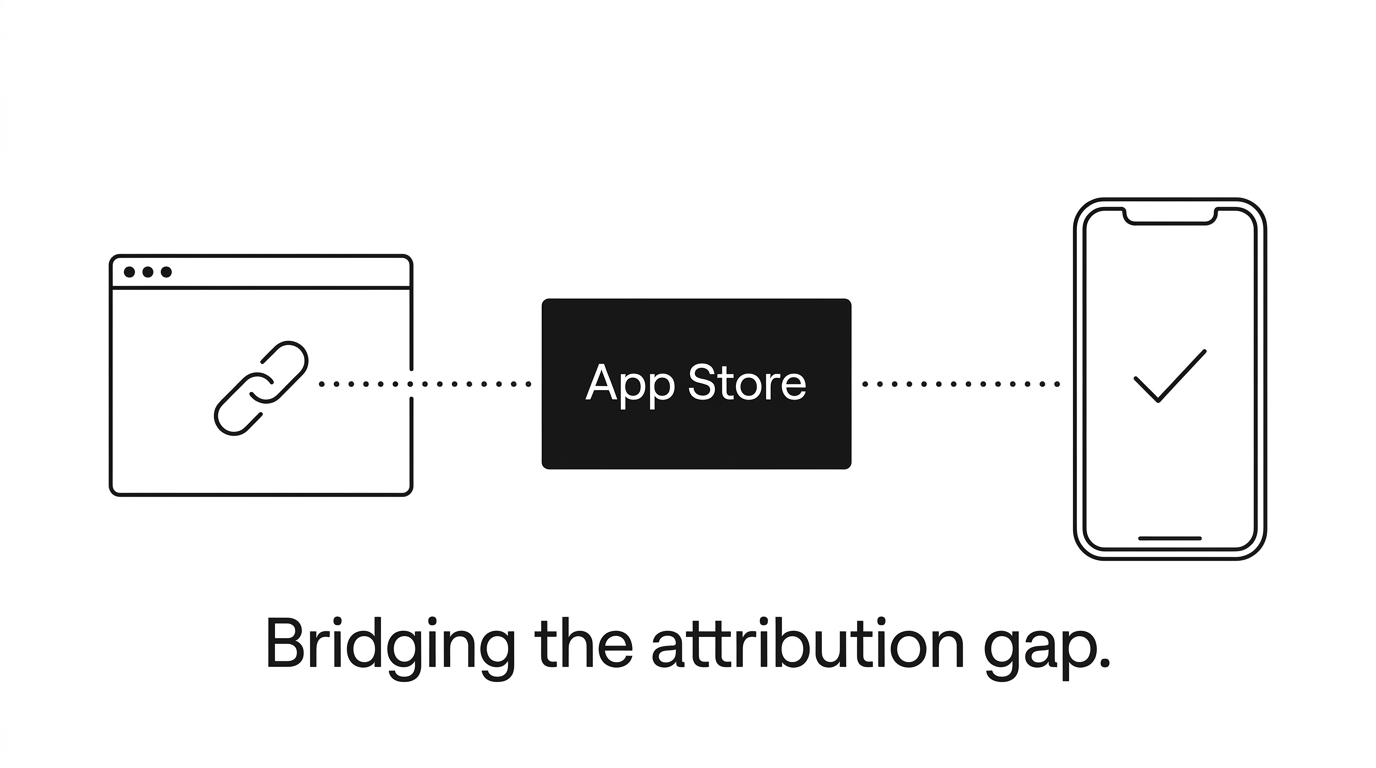
Why is influencer attribution so hard for mobile apps?
So on the web, you know where this goes: if someone clicks a link on a webpage and it drives them to a website, the website drops a cookie and it knows where they came from. When that person purchases something, it reads the cookie and credits the referrer. This is 15-year-old technology, so not a problem.
Apps break all of these assumptions: the user clicks a link in a browser, or they click a link inside an app like TikTok or Instagram or YouTube, and it redirects to an app store where they install and then open an app. The app has no idea where that user came from. There's no cookie. There's no referrer header. There's no query string. The browser session and the app session are totally isolated. They're in different sandboxes. They don't share any state.
This is what's known as the "app store black box": every install funnels through it, and attribution data doesn't survive. It's the biggest technical challenge in mobile marketing, and it's why a 2025 survey by Aspire found that only 28% of marketing teams are confident in their ability to attribute installs back to individual pieces of creator content.
Everything else is doing what you would expect: looking at aggregate lifts in installs during a campaign and just sort of...guessing. You run ten influencers. You see a 30% overall lift in installs. You declare victory! But which influencers actually drove those installs? And which ones drove users who actually paid you? No idea. And that sort of uncertainty ends up infecting every decision you make around which influencers to re-sign, and what commission rates to offer them, and whether this stuff is even "working" at all.
How does web attribution differ from app attribution?
These are different for a reason, as there are real-world implications to this, in terms of what solutions actually solve the problem.
Web flow: User clicks a link with a tracking parameter, User lands on website, Website reads the parameter, Cookie gets set, User purchases, Website reads cookie, Attribution complete. Everything happens in the browser. One context, one environment, unbroken chain. App flow: User clicks a link in browser or social app, User gets redirected to App Store or Google Play, User installs app, User opens app, App tries to figure out where the user came from. At the store redirect, the chain breaks, as there are two different environments with no shared data.The core enabler for web attribution is cookies, and cookies don’t exist across the browser-to-app boundary. Apple’s Intelligent Tracking Prevention in Safari blocks third-party cookies altogether. Apple’s Private Relay, which Apple said hit more than 130M subscribers in early 2025, anonymizes IP addresses for many iOS users. Even on Android, where the browser is less locked down, you still have the basic issue that the Play Store sits between the click and the install.
This isn’t something you can solve by cleverness with URLs. It requires purpose-built attribution technology on both sides of the gap, the click side and the install side.
How does modern attribution bridge the app store gap?
It’s a combination of a tracking link system (on the click side) and an SDK in your app (on the install side).
The click side: Every creator has a unique tracking link. When a user taps it, we see the click, including the creator ID, timestamp, and device signals accessible in the browser. The user is then redirected to the app store. The install side: Your app contains an attribution SDK. On the first launch of the app, the SDK collects device signals in the app context and pings them to an attribution server. The server checks those signals against recent click data to find a match.If we find a match, we attribute the install to the creator who got tapped. The creator can see the install in their dashboard. If you’ve integrated a subscription platform, any subsequent purchase and renewal also get attributed to them.
The beauty of this system is that neither side needs to know about the other beforehand. The click system observes clicks. The SDK observes installs. We match the two server-side, after the fact. No cookies required. No cross-app tracking. No user-facing permissions.
How does Android attribution work?
Android is the good news story. Google’s Install Referrer API provides a deterministic attribution method that passes referral data through the Play Store.
When a user clicks on a tracking link, the link contains referrer parameters. Those parameters are attached to the Play Store install session. When the user installs and opens the app, the attribution SDK reads the referrer data from the Install Referrer API. The match is exact, no probability.
Per Google’s 2025 developer documentation, the referrer data persists for up to 90 days after the original click, even for very late installs. And the API is available on nearly all Android devices that support Play Services, about 95% of the total Android market, per Statista’s 2025 estimates.
The result is strong accuracy on Android. Most attribution platforms achieve 85-90% attribution rates for click-to-install. The remaining 10-15% usually are edge cases, users who clicked a link but then searched for the app in the Play Store, users who installed on a different device, or users who clicked on multiple links before installing.
For influencer programs, Android attribution is largely a solved problem. The technology works, it’s deterministic, and it’s been stable for years. If every user was on Android, this blog post would be three paragraphs long.
How does iOS attribution work without IDFA?
This is where we have to explain the biggest difference between Google and Apple when it comes to attribution. Apple doesn’t have a direct equivalent to the Install Referrer API. That’s the problem we’re trying to solve. Apple’s App Tracking Transparency means that apps have to ask permission to access the IDFA (Identifier for Advertisers). And according to Adjust’s 2025 Global App Trends Report, only about 18% of users are opting in. For social and entertainment apps, that rate is about 12%. As far as attribution is concerned, the IDFA is basically dead. On iOS, we have to use more modern attribution techniques that don’t rely on cross-app tracking or an IDFA. The actual technology will depend on the specific attribution provider you choose, but the idea is to use signals that are always available, without requiring any special permission or presenting a tracking prompt to the user. No ATT prompt. No IDFA. No cross-app tracking. The user never sees the “Allow this app to track you?” prompt. And this actually makes a big difference, since a 2025 study by Storemaven found that showing the ATT prompt during onboarding decreases Day 1 retention by 8-15%. The downside is that these methods aren’t always accurate. iOS attribution is probabilistic, not deterministic. Some installs will always be unattributable, such as users on VPNs, users who wait days between click and install, users sitting behind the same network address. If an attribution platform is being honest with you, they won’t claim 100% accuracy on iOS. But the real question here isn’t “is it perfect?”; it’s “is it good enough to run a program on?” And the answer is yes. Going from “we have literally no idea which influencer drove which install” to “we can attribute most installs with a pretty high degree of certainty” completely transforms how you’re able to allocate budget and work with creators.
Can you use SKAdNetwork for influencer attribution?
No. I really wish I could give a more complicated answer here. But I can’t. Apple’s SKAdNetwork (SKAN) does offer privacy-preserving attribution for ad networks. However, it was not designed for influencer networks, and it falls short in all of the ways that matter: 1. No per-creator granularity: SKAN uses campaign IDs, and you can use a maximum of 100. Even if you were able to assign a campaign ID to each creator, you’d be capped at 100 influencers. Most programs expect to work with more than 100 creators. And all SKAN data is reported in aggregate, you can’t determine which individual users are associated with which campaign. 2. No real-time reporting: SKAN postbacks are delayed by a minimum of 24-48 hours, and then Apple introduces additional random delays for privacy. Creators expect to be able to view their results in real-time. A 2025 study by CreatorIQ found that creators who had same-day insights into their performance created 67% more content per month than the average creator. A measurement system that only reports results after a 2-day delay would break the feedback loop entirely. 3. No revenue measurement: Each SKAN install can have a conversion value of anywhere from 0 to 63. This is not nearly enough resolution to measure revenue at the creator level. You need to know that Creator Sarah’s users generated $340 in subscription revenue this month. You can’t do that with SKAN. 4. No Android support: SKAN is only for iOS. Any legitimate influencer measurement system needs to support both iOS and Android. SKAN fills a critical need: it gives ad networks aggregated performance measurement that preserves user privacy at massive scale. But for measuring creators, you need per-creator measurement, real-time measurement, and revenue measurement. None of these capabilities are available in SKAN.
What does the attribution flow look like end-to-end?
Here's an example to illustrate this.
Day 0: Setup. You add the attribution SDK (3 lines of code in your app's bootstrapping code). You hook up your subscription platform (RevenueCat, Stripe, etc.) via a webhook. You generate tracking links for your creators.Appfiliate.configure(appId: "APP_ID", apiKey: "API_KEY")
Appfiliate.trackInstall()
Appfiliate.setUserId(Purchases.shared.appUserID)yourapp.appfiliate.io/hdwud1, in the video description.
Day 1-7: Installs trickle in. People watch the video, and some click on the link. The attribution system records the clicks. People download the app from the App Store and Play Store. When they open the app for the first time, the SDK matches the app install to the creator's link. When the creator logs into her dashboard, she sees: 12 installs on day 1, 8 on day 2, and 3-4 installs per day by day 7.
Day 7-30: Revenue attribution. Some of those users start a free trial. Some of them upgrade to paid. Your subscription platform sends a webhook for each new payment. The attribution system ties those payments back to the creator. By day 30, the creator sees in her dashboard: 89 installs, 14 paid users, $126 in attributed revenue.
Day 30+: Compounding. The YouTube video continues to get views through search. Installs continue, albeit at a slower rate. According to Tubular Lab's 2025 data, YouTube review content generates 55% of its lifetime views after the first 30 days. Months after posting a single video, the creator is still generating installs and revenue.
That's the entire funnel. From click to install to revenue to creator payout. No spreadsheets. No manual matching. No ambiguity about which creator generated what revenue.
What tools are available for influencer attribution today?
THE STATE OF INFLUENCER ATTRIBUTION The space is young, so there aren’t many options here, but I’ll run through a few: Enterprise MMPs (AppsFlyer, Adjust, Singular) can do influencer attribution, but they’re built for paid ads. It’s a heavy implementation, it’s $500+/month (annual contract required), and they don’t have the creator dashboards and commission tracking, etc. You can use an MMP for this, but it’s overkill and expensive. I did a writeup comparing Appfiliate, AppsFlyer, and Branch if you want the details. GoMarketMe does app affiliate programs, with a no-SDK setup using Apple Search Ads attribution. So you need to run some Apple Search Ads campaigns and use their attribution framework, which doesn’t give you the deterministic matching, and (of course) is only good for iOS. (And the Apple attribution system isn’t nearly as flexible as using an attribution vendor directly). You can build it yourself. Larger teams do this, which is fine if you have a few full-time engineers who don’t have anything else to do. But attribution edge cases (VPNs, delayed installs, different OS versions, device migrations, etc) stack up fast. I haven’t talked to a single developer who tried to build their own system and didn’t regret the decision after 6 months. (The upkeep compounds, while it’s not even a core part of your product). Custom Product Pages. Apple introduced these a while back, which lets you create unique variants of your App Store page, and give each creator a unique link to their page. Downsides: max of 35 per app, only aggregate analytics, no revenue-level attribution, 24 to 48 hour delay on analytics, and it’s iOS only. We cover why Custom Product Pages aren’t an affiliate program in detail.
What are the honest tradeoffs in 2026?
I want to be upfront about what can’t be done rather than gloss over those items.
iOS attribution is not deterministic. No matter who is telling you otherwise, any iOS attribution without the use of IDFA is based on probabilistic matching. That’s ok, it’s a hell of a lot better than nothing, but that means that there will be some percentage of installs that cannot be attributed. The teams that are succeeding with their influencer programs acknowledge that and plan around it rather than deny its existence. Attribution windows are a thing. A user may click on a link on a Monday and not install until Thursday. The longer the attribution window the more likely you are to capture that install, but the more likely you are to pick up false positives. The vast majority of platforms have a 7-day attribution window, which seems like a decent middle ground. Just be aware that any user who clicks and waits longer than the length of the attribution window will be attributed as an organic install. Fraud is a thing in influencer marketing as well. Click farms, bot installs, fake engagement. A 2025 report by CHEQ estimated that 15% of global influencer marketing traffic is fraudulent. Solving for attribution solves the measurement problem, but you still need to monitor for suspicious activity, such as a huge number of clicks with very low conversion to installs, installs from geographies where you don’t have activity, users who install and then immediately uninstall. Multi-touch attribution is largely irrelevant. In paid social and ad networks, a user may see multiple ads before finally installing. That’s why MMPs need to have multi-touch attribution models. In influencer attribution, it’s almost always single touch, as the user clicks on one link and installs. According to data from AppsFlyer in 2025, the average affiliate attribution flow involves 1.1 touches per install. One of the advantages of the attribution models is their simplicity. The fewer components and complexity there are, the fewer things there are to screw up.The net of this is that as of 2026, influencer attribution for mobile apps is very solvable on Android and meaningfully solvable on iOS. The tech exists. The tools exist. Teams that are still attributing their influencer campaigns based on “installs went up that week” are opting to do so despite having the data at their fingertips. And in a market where so much emphasis is being placed on retention and LTV, choosing to fly blind on attribution is an increasingly expensive decision. If you're ready to put attribution to work, our guide on how to set up an affiliate program for your mobile app covers everything from commission structures to creator recruitment.