Custom Product Pages Are Not an Affiliate Program
Custom Product Pages are great for A/B testing, but they fall short as an affiliate tracking solution. Here's what they can and can't do, and what you need instead.
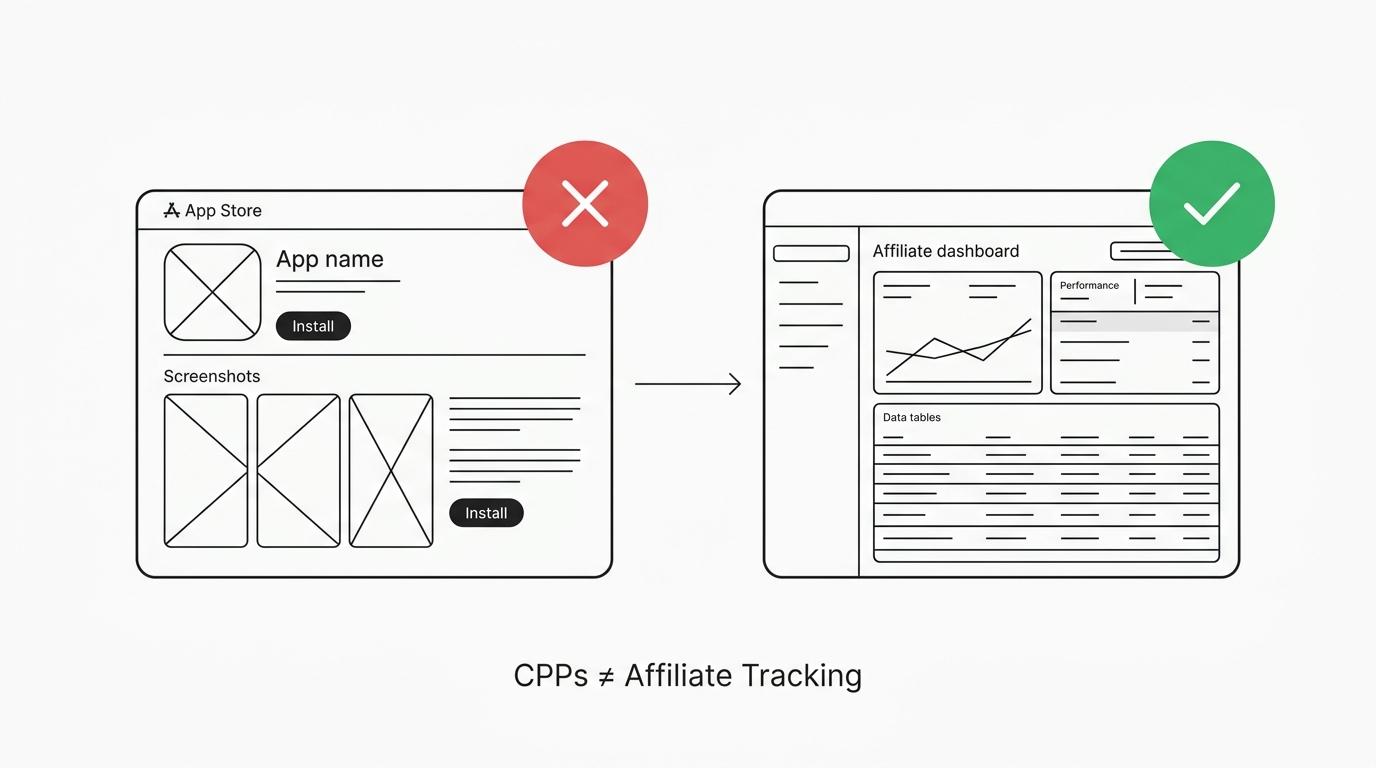
Some of you have attempted to transform Custom Product Pages into an unofficial Apple affiliate program. I get the thought process: assign a unique CPP to each content creator, lookup the results in App Store Connect, and then perform the calculation on the back of a beer coaster. I see what you did there. Unfortunately, the house of cards quickly collapses. CPPs are an extremely valuable tool for developers: you can have up to thirty-five variations of App Store pages, each with different screenshots, trailers, and promotional descriptions. They are perfect for A/B testing and campaign-specific promotions. But they are not meant for affiliate tracking, and this is why:
How many Custom Product Pages can you actually create?
Apple limits you to 35 Custom Product Pages. Period. With 10 creators across 3 media channels each, you've already consumed 30 of them. That leaves five more, and then you’re out. An affiliate program that’s capped at 35 links isn’t an affiliate program. It’s a tiny rounding error. It’s nothing. This issue compounds itself the more you scale. According to Influencer Marketing Hub’s 2025 Benchmark Report, the average program reaches 50-100 creators in the first year alone. The tiniest of programs will be past 35 links in a matter of weeks, and then you’ll be forced to start reusing pages, which negates the benefit of per-creator tracking in the first place because the data won’t be clean. Then there’s the pure practicality of this. Each Custom Product Page has to be approved by Apple’s App Review team. Every. Single. One. That means you’re waiting 24-48 hours (at least) every time you bring on a new creator. That’s compared to an affiliate platform where they can register, receive a link, and share in minutes. The operational burden here is enough to rule out CPPs from ever being a serious program.
Why can't Custom Product Pages track revenue attribution?
This is the crux of the problem. App Store Connect provides total impressions and installs per page, not user. So you can see that “Creator Sarah’s Page” drove 150 installs. But you can’t see which of those users paid for anything, how much revenue they generated, or if they even opened the app twice. Without user-level attribution, RevShare isn’t really possible. You have no way to determine the value of a creator’s audience. You’re stuck with flat rate CPI, and even that data is 24-48 hours delayed. This matters more than most developers appreciate. According to AppsFlyer’s 2025 State of App Marketing report, the difference in revenue between the highest- and lowest-performing acquisition channels can be as high as 8x when looking at LTV over 90 days. If you’re treating all of Sarah’s installs as created equal (because that’s all the granularity CPP analytics offers) you’re only seeing part of the picture. You may be overpaying for terrible installs and underpaying the creator whose audience spends a lot of money in your app. And it’s not just a matter of optimizing spend. Without revenue attribution, you can’t answer the single most important question in affiliate marketing: is this partnership profitable? You’re in the dark, and you’re asking your creators to join you there.
Why do Custom Product Pages fail for cross-platform apps?
On Android, there is no CPP. If you’re a cross-platform app, and you probably are, then CPPs only measure half your installs. At best. Based on Statista’s mobile OS market share data for 2025, Android accounts for about 72% of the global smartphone market. In the US, where iOS is most popular, Android still makes up around 45%. For most apps, CPPs measure between one-third to one-half of your total installs.
You basically have to kludge two entirely different systems together, with two different sets of reporting. What you get from App Store Connect … and whatever Frankenstein’s monster you build for Android, probably Google Sheets plus UTM codes and prayers. Not ideal. Nor particularly scalable. For every new creator you bring on, you’re essentially doubling the work of setting things up and the work of reconciling the reports.
How do CPPs fail creators who need performance visibility?
Performance reporting. Creators want to see how they're doing. Clicks, installs, earnings. With CPPs, they get nothing. You'd have to manually pull data from App Store Connect and send it to each person. With 5 creators that's annoying. With 50 it's a full-time job. And when creators can't see their own numbers, they stop caring pretty quickly. Here's what this looks like in practice. Say a creator posts a video about your app on Tuesday afternoon. With an affiliate platform, they can check their dashboard that evening and see "14 installs, 3 paid conversions, $8.40 earned." That feedback loop is what keeps them posting. With CPPs, they hear nothing until you remember to log into App Store Connect a few days later, export the CSV, find their page in the spreadsheet, and email them a number that doesn't even include revenue data. By then the moment is gone. The creator has moved on to promoting something else, something that gives them real-time feedback. This isn't a minor UX issue. It's a retention problem for your entire creator program. A 2025 CreatorIQ study on creator program retention found that 67% of creators cited "lack of performance visibility" as a top reason for dropping out of brand partnerships. Creators are running businesses. They allocate their time toward the partnerships that give them feedback and away from the ones that feel like shouting into a void. If your competitors have real dashboards and you're sending CSV screenshots over email, you're going to lose your best partners.How do you manage commissions and payouts without a platform?
- But that's just the analytics side. Now you have to figure out how much each partner has earned, keep track of who's been paid, manage varying commission rates and terms, and actually deliver the cash. CPPs don't help with any of this. So you're back to spreadsheets, and "did you pay me for last month" support emails. This is the operational part that breaks most CPP-based mobile affiliate programs within a few months. I've spoken with several developers who have tried this, and the tale is always the same. Month one is OK, you have three partners, the spreadsheet isn't that complicated, and you can handle PayPal payouts manually. By month three, you have a dozen partners, all on different terms, with some stuff in dispute, others claiming late payments, and one partner whose accountant is now asking for an invoice. The whole thing breaks down under its own weight, and the developer decides that "affiliate marketing doesn't work for apps." Except, of course, that it does; they just lacked the right infrastructure. An actual affiliate platform calculates commissions under whatever model you're using, CPI, rev share, some hybrid, etc. (We cover how to structure influencer payments in detail.) It tracks payments, and lets partners see balances and histories. Disputes are minimal because everyone's working off the same data. It's the difference between actually having a program and pretending to have a program by using a spreadsheet.
| Capability | Custom Product Pages | Affiliate Platform |
|---|---|---|
| Tracking links | Up to 35 total | Unlimited |
| Platforms | iOS only | iOS + Android |
| Attribution | Aggregate (page-level) | Per-user |
| Revenue tracking | Not available | Per-creator |
| Real-time data | No (24-48hr delay) | Yes |
| Creator dashboard | No | Yes |
| Commission management | Manual | Automated |
| Payout tracking | Manual | Built-in |
| Apple review required | Yes, per page | No |
| Scalability | Maxes out at 35 | Unlimited creators |
What should you actually use Custom Product Pages for?
Custom Product Pages are awesome for App Store optimization, for segmented ad campaigns, and for testing feature prioritization. Nice tool. Just not an affiliate tool. If you need actual per-creator attribution, a lightweight attribution SDK is the right approach.
This is what CPPs are actually good for. Are you running Apple Search Ads? Make a CPP for a keyword cluster, with screenshots and descriptions that match the search term. Want to test whether “save money” or “build wealth” is a better value prop for your finance app? That’s what CPPs are for. According to Apple’s case studies, well-targeted Custom Product Pages can increase ad conversion rates by up to 35% compared to a standard product page.
You can also use CPPs for holidays, for geotargeting, or for other ad targeting parameters. Just don’t get “I can make a unique link” confused with “I can track an affiliate partner.” Those are totally different things.
If you want to actually launch a program, our guide to launching a mobile app affiliate program goes over everything from payouts to partner outreach.
It’s an understandable mistake, as CPPs kinda look like tracking links from a distance. But the distance between “I can see how many people downloaded my app from a page” and “I know which partner brought me which paying customer” is enormous. That distance is the distance between a vanity metric and a partnership that actually functions. And if you’re not sure if partnerships are worth your time compared to running ads, we’ve written up a piece on why creator marketing tends to beat paid ads for app growth.